
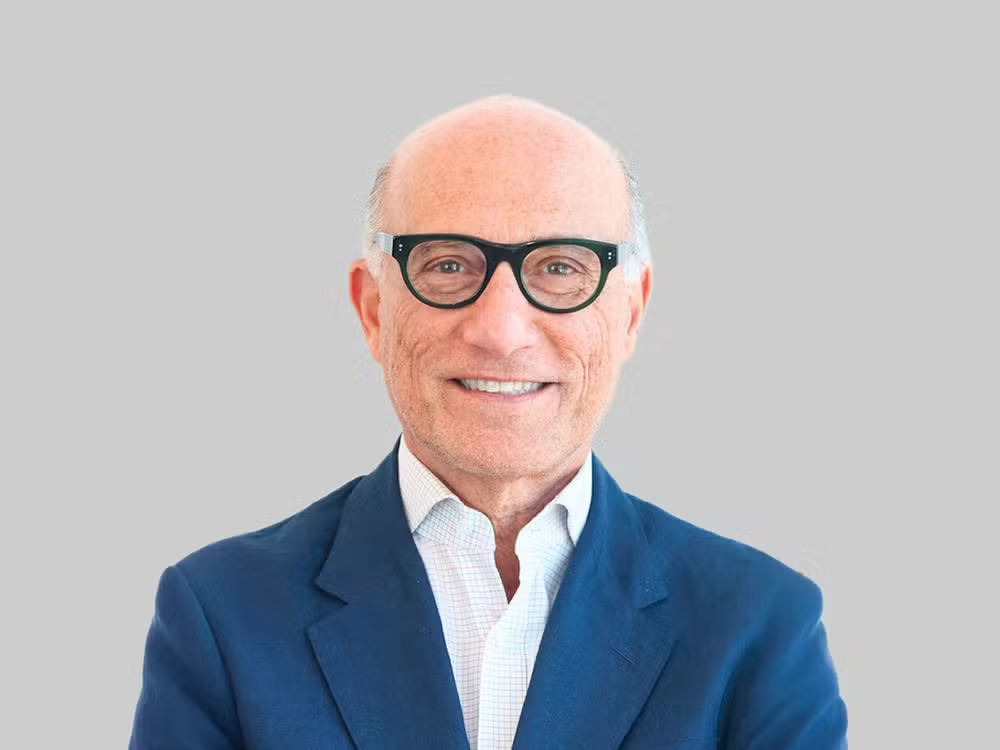
Rio de Janeiro has been boosting the innovation sector and, in recent years, has started positioning itself as one of the main technology hubs in Brazil and Latin America. The movement is part of a strategy by Rio’s city hall to attract investment and strengthen the city’s economy, led by Invest.Rio, the municipal agency responsible for promoting and attracting companies. “There is global competition among cities. And you can only win it if you have a strategy. The strategy is to explore what you do best. We understand that technological innovation is the main engine of growth in the world, so this was a planned and essential move for Rio to gain economic prominence,” says Sidney Levy, president of Invest.Rio.
In recent years, the city has brought together initiatives focused on technological development and talent training, strengthening an innovation ecosystem that involves universities, research centers, and technology companies. Examples include Porto Maravalley, a startup and innovation hub located in the port area, and the Institute for Pure and Applied Mathematics (IMPA), an international reference in scientific research. According to Levy, Rio combines two important factors for advancing this ecosystem: qualified professionals and creativity. “We have great engineering and mathematics schools, and universities graduate ten thousand professionals in the field every year. This is essential for the city’s development. And in this world of artificial intelligence (AI), creativity — which is still a human trait — will be important. That’s an attribute Cariocas have,” he says.
Invest.Rio works by connecting different players in this environment, creating conditions for companies to set up in the city and generate opportunities for qualified professionals. “We create conditions in terms of location, security, regulation, access, and energy supply. Everything so that companies come and establish themselves here. We want them to feel welcome in Rio, to find a friendly environment, and for that to generate jobs,” says Levy.
Digital infrastructure and artificial intelligence
One of the projects expected to boost this movement is Rio AI City, developed by Rio’s city hall and the federal government, together with Elea Data Centers, with the goal of positioning the city as a technology and AI capital. The initiative plans to create a digital infrastructure hub focused on advancing artificial intelligence and cloud computing in Brazil and Latin America. Construction is expected to begin in 2026. “The city will gain computing capacity. There will be many servers, CPUs, and elements that allow AI to be installed in the city. It will be the largest project in Latin America. Rio will be able to export services to all of Brazil and the continent,” explains Alessandro Lombardi, president of Elea Data Centers.
Lombardi highlights that Rio has important structural conditions to host a project of this size, especially regarding energy availability. “Rio, because it was once the capital, was placed at the center of the country’s energy transmission network. Energy comes from large renewable sources and hydroelectric plants,” he notes. The structure will have an initial capacity of 1.5 gigawatts (GW) of 100% renewable energy, with potential expansion to up to 3.2 GW. For Levy, initiatives like this could place Rio among the cities that will lead the digital economy in the coming decades. “We have a thesis that there will be between 15 and 20 global cities in the future. These places will need abundant data processing capacity, clean energy, housing availability, and quality of life. Two or three of these cities will be in South America. If Rio manages to be among them, our mission will be accomplished. And Rio AI City is fundamental in this process,” Levy adds.
BYD testing center
Another project expected to strengthen the city’s positioning as an innovation hub is being led by BYD, a global reference in the production of new-energy electric vehicles. The company plans to create Brazil’s first Automotive Testing and Evaluation Center and a new platform for experiences, research, and development in Rio, next to RIOgaleão – Tom Jobim International Airport.
The company’s goal is to process autonomous vehicle data in a laboratory and test vehicles in real Brazilian environmental conditions, on a track designed for trials that will be located next to the research center. “BYD will bring many people from China to develop the autonomous car project here in Rio. And it will bring people from all over South America to visit the facility. And it will certainly attract companies that will work for it,” celebrates the president of Invest.Rio.
Levy sees the new technological developments as part of a broader innovation strategy for the city. With the arrival of the BYD and Rio AI City projects, Rio will begin concentrating technology hubs in different regions, such as Barra da Tijuca, Ilha do Governador, and downtown.
At the same time, the city invests in initiatives that strengthen other sectors of the economy and help create a favorable environment for new businesses. “Rio has no alternative but to invest in this field. The city is already innovative. Invest.Rio has been dedicated to developing the tourism sector, reopening closed hotels, encouraging new flights and connections to the international airport, and also developing the real estate segment by revitalizing the city center. We are living a good moment, we have political stability. The movement now is to attract companies here,” Levy highlights.