
Source: Matheus Prado – Brazil Journal
Istanbul, China, San Francisco.
These are, in order of likelihood, the three international routes that could be added to Galeão’s network in the coming months.
The negotiations are described as complex, but expanding Rio’s air network is being treated as a priority by Invest.Rio — the city agency focused on attracting investment.
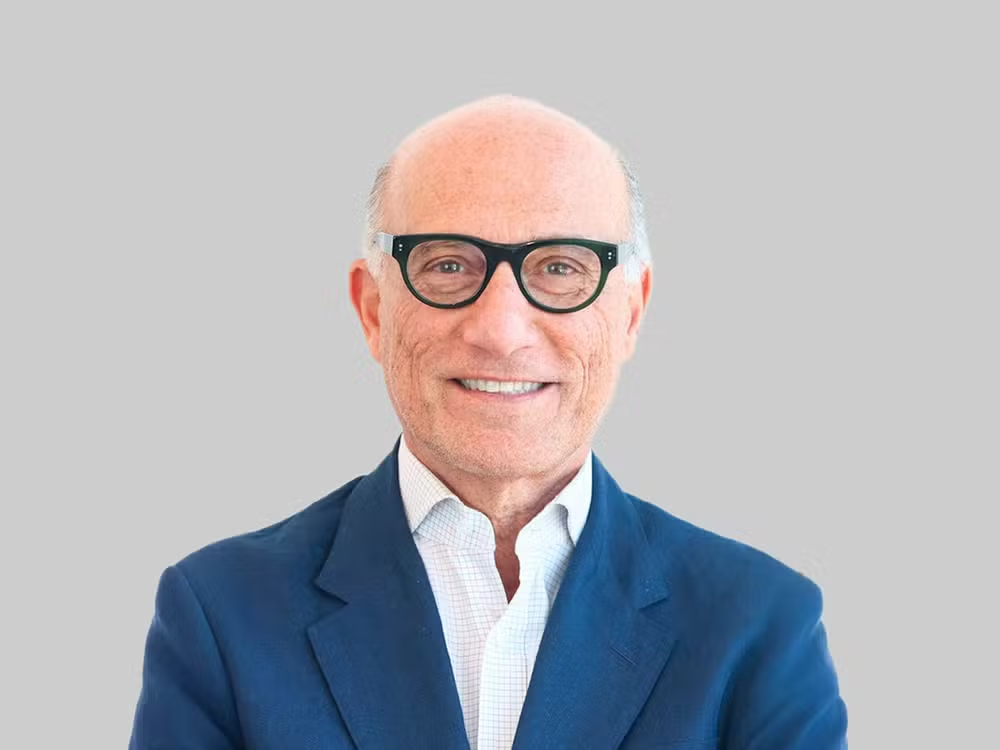
“Tourism is a major driver of development for Rio, and air connectivity is essential for the city to grow,” said Sidney Levy in an interview with Brazil Journal.
Rio welcomed 2 million tourists last year, while Cancún received 10 million, which, according to Levy, leaves plenty of room for growth for the Marvelous City.
According to him, the focus must be on a three-part strategy: accommodation, an events calendar, and air connectivity — with the latter currently being Rio’s least developed pillar.
After more than three decades in the private sector, with roles at De La Rue and Valid, Levy led the organization of the 2016 Summer Olympics and says today’s scenario is completely different.
“At the time, we made a Herculean effort to increase the city’s hotel room supply from 20,000 to 40,000, which was what the International Olympic Committee required. Today we have 60,000 rooms and 20,000 Airbnbs, in addition to a much more complete events calendar,” he said.
Meanwhile, Galeão International Airport was affected by the pandemic and by political efforts to reduce its flight volume in favor of Santos Dumont Airport, falling to just 6 million passengers per year, versus 17.5 million last year (while São Paulo/Guarulhos International Airport handled 47 million).
“That’s why we launched the New Routes program, designed to support airlines willing to operate destinations not currently served from the city,” Levy said.
Created to attract foreign carriers, the plan includes discounts on airport fees during a route’s first months and short-term subsidies if the route takes time to gain traction — which initially caught the attention of Gol Linhas Aéreas.
The airline controlled by the Constantino family turned Galeão into its Brazilian hub and has recently announced routes to New York City (launching July 8), Lisbon (September 16), Orlando (date TBD), and Paris (date TBD).
But Invest.Rio has not given up on international airlines and last month hosted Routes World, bringing more than a thousand network planners to the city — professionals responsible for mapping fares and passenger flows to define airline priorities.
“There is tremendous enthusiasm among foreigners regarding Brazil, but route development is a complex process involving logistics, maintenance, hub positioning, pilot training, advertising,” Sidney said. “These are decisions that carry a lot of risk.”
Negotiations with Turkish Airlines for a Rio–Istanbul route are currently the most advanced. It would give Rio a direct link to Europe’s second-busiest airport and another connection to the East beyond the existing Rio–Dubai service operated by Emirates.
Following a visit by Levy to China, Invest.Rio also began talks to establish a route between Rio and the Asian giant, though discussions have not yet advanced to a specific airline or destination.
A link between Rio and the U.S. West Coast — specifically San Francisco — appears to be the hardest to make happen for now.
“This route would be ideal to support the development of our AI City (the data center park under construction in Barra), but U.S. airlines are reluctant,” Sidney said. “There are factors such as seasonality. During the Northern Hemisphere summer, for example, it’s unthinkable for them to pull aircraft from Europe routes, where Americans vacation.”
Beyond incentives, Invest.Rio is also counting on the arrival of Aena at Galeão as a new bargaining chip, since the Spanish operator maintains agreements with major global airlines at airports such as Adolfo Suárez Madrid–Barajas Airport and Josep Tarradellas Barcelona–El Prat Airport.
Today, Galeão operates direct flights to New York City, Atlanta, Miami, Houston and Dallas, while also connecting Rio nonstop with major European and South American capitals, as well as Panama City, Toronto, Montreal and Dubai.